
Teacher Sorted · 18 September 2026 · 9 min read
The Sunday evening teacher workload trap
Learn to capture workload early, compare tasks with genuine available time, prioritise realistically and use Sunday as a brief re-check rather than a rescue session.

There is a particular point on a Sunday evening when the week ahead stops being theoretical.
You look at Monday’s lessons, the marking still waiting, the meeting on Wednesday, the parent email you promised to answer and the resource that needs preparing. Then you realise that the week contains far more work than the time available to do it.
So you start planning.
Or, more accurately, you start trying to rescue the week.
This is not an argument that teachers should never work on a Sunday. Sometimes Sunday is the only time that feels available. Sometimes a short planning session makes Monday morning less painful. Teaching does not always fit neatly between 8.30 and 3.30, however much we might wish it did.
The problem comes when Sunday evening is the first time you properly look at the week ahead.
By then, the difficult decision has already been left late. You are trying to squeeze an impossible amount of work into the few hours before Monday. That is where the Sunday evening teacher workload trap begins.
Notice what Sunday is telling you
If Sunday work happens occasionally, it may simply be part of a busy week.
If it happens most weeks, Sunday may be showing you a problem that started earlier.
The coming week was never planned against the time you actually had.
That is an easy thing to miss. Most planning starts with the work:
- Plan next week’s lessons
- Mark the books
- Prepare the assembly
- Reply to parents
- Update the assessment information
- Sort the resources
- Complete the training task
The list is usually accurate. Those jobs may all matter.
But the available time does not grow just because the list is honest.
You might have three PPA sessions, a staff meeting, a duty, a parents’ evening and an appointment. One of your PPA slots may be taken by cover. Another may be interrupted by a safeguarding concern or a child who needs a conversation.
That is the week you have.
Planning as though you have five clear afternoons will not make those afternoons appear.
Research commissioned by the Department for Education continues to show how difficult this is for teachers. The 2025 Working lives of teachers and leaders report found that many teachers work outside school hours in the evenings and at weekends because the volume and mix of tasks do not fit into the available time.
That matters because this is not simply about becoming better at managing a list. There is often more work than working time.
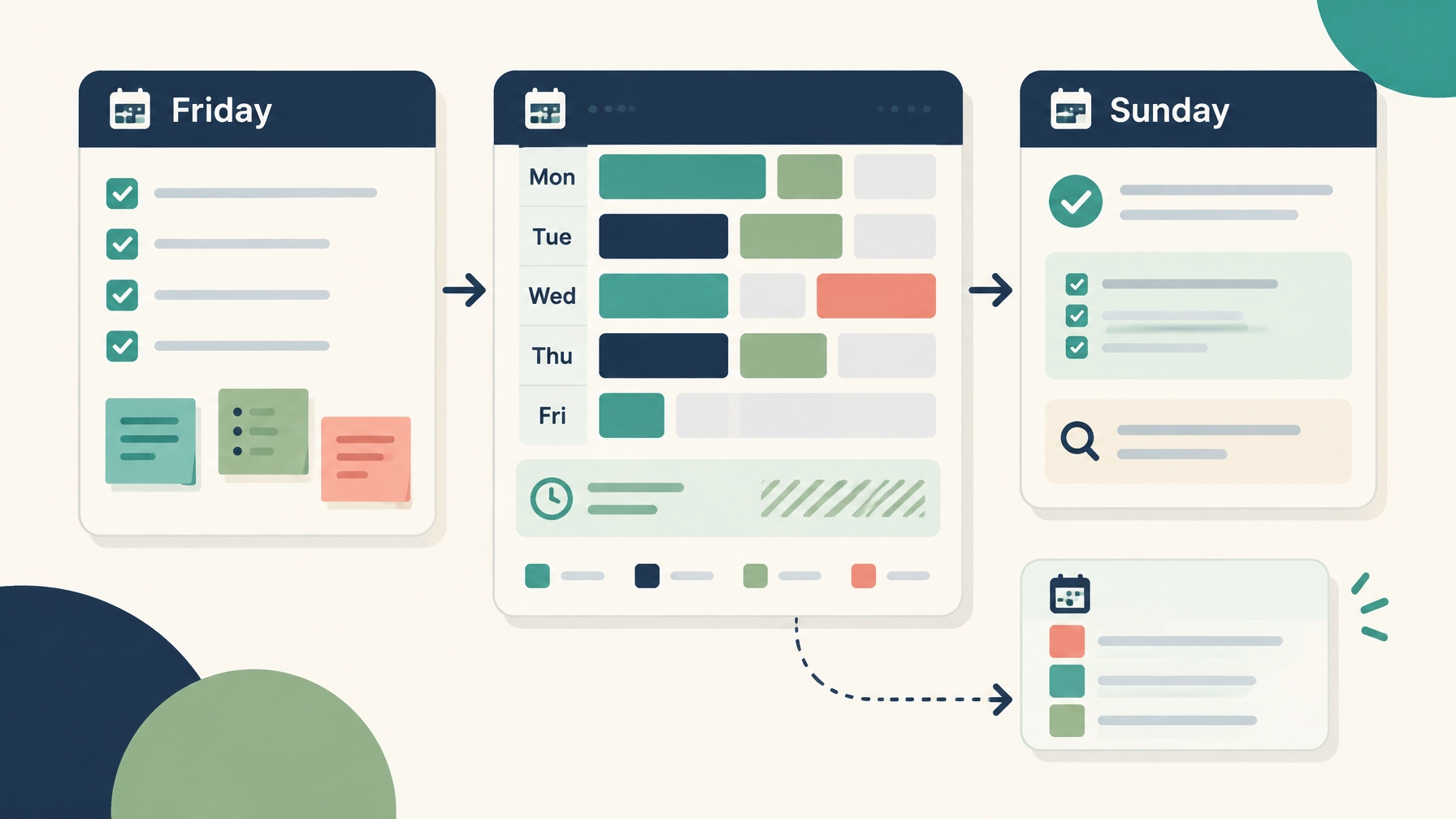
Capture the work before Friday ends
A useful way to make Sunday easier is to move the first look at the week to Thursday or Friday.
Not the finished plan. Just the work.
Get the jobs out of your head while they are still connected to the conversations, emails and lessons that created them.
Your notes might look like this:
- Mark Year 5 writing before Friday
- Plan Monday maths
- Reply to Ellis’s parent
- Find resources for Thursday’s experiment
- Update the intervention list
- Bring assembly idea to Tuesday meeting
- Check reports before sending
These do not need to be polished. They should sound like the notes you would actually write when someone stops you in the corridor.
The point is to capture the whole shape of the work before the weekend starts. Otherwise, jobs arrive one at a time on Sunday, each one bringing its own small jolt of worry.
You can then separate what needs attention next week from what can stay on the wider list.
That distinction is important. A task can be real without belonging to Monday morning.
Look at the time before you promise the work
Once you have captured the work, look at the time available in the week ahead.
Include:
- PPA sessions
- Preparation periods
- Existing meetings
- Duties and supervision
- Before-school or after-school time you have chosen to use
- Appointments and personal commitments
- Any part of the week that is already likely to be disrupted
You do not need to account for every minute. You do need an honest picture of the useful time you have.
It is also worth judging the shape of that time.
A 20-minute gap may be enough to print resources, send a straightforward email or update a list. It may not be enough for detailed marking or planning a new sequence of lessons.
A longer block may suit:
- Lesson preparation
- Assessment
- Detailed marking
- Report writing
- Work that needs proper concentration
Shorter blocks may suit:
- Printing and copying
- Sending one email
- Finding a resource
- Updating a tracker
- Preparing materials for tomorrow
This sounds basic, but it stops you putting every kind of work into every kind of gap. That is one reason plans can look reasonable on paper and still fall apart by Tuesday.
PPA should also remain visible as the time it is meant to be. The NEU guidance on PPA time explains the position for teachers in England. Timetables and practice vary, but your own plan still needs to reflect the time you can genuinely use.
Decide what fits before Sunday
When you compare the work with the time, you may find that it fits.
That is useful information. You can stop trying to improve the plan and get on with the work.
You may also find that it does not fit.
That is useful to know while there is still time to adjust. You might:
- Protect the work needed for tomorrow’s lesson
- Complete the task with the fixed deadline
- Reduce the detail in a resource
- Reuse something you already have
- Move a task to next week
- Ask someone else for information
- Discuss a deadline that no longer fits
- Decide that a job is not needed after all
There is no prize for discovering the problem at 9.30pm on Sunday.
A simple question can help:
What will happen if this waits until Tuesday?
For some tasks, the answer is that something important will be affected. Deal with those first.
For others, the answer is that the work will still be there, but nothing serious will happen. Give it a later place.
Some tasks feel urgent because they are visible and unfinished. That does not always make them the best use of the next hour.
This is where professional judgement matters. You are not trying to make every task disappear. You are deciding what the time can hold.
Leave room for school to behave like school
Even the best weekly plan cannot predict every conversation at the classroom door.
A meeting runs over. A pupil needs support. A colleague is absent. A safeguarding issue takes priority. The maths lesson goes better than expected but takes twice as long.
These things are not planning failures. They are part of the job.
A plan that fills every available minute leaves no room for them. When one small thing changes, the whole week appears to be behind.
Try leaving some space between the work and the time available. If you have three hours of useful non-teaching time, you do not necessarily have three hours of work time.
That spare room gives you somewhere to put the unexpected. It also makes it easier to adjust without turning every change into an evening at home.
The Education Endowment Foundation’s review of teacher workload makes a similar wider point. Workload is shaped by the volume of tasks, the support available and the way schools organise the work. It cannot be solved by asking teachers to become more efficient indefinitely.
Make Sunday a re-check, not a rescue session
A better Sunday evening does not have to mean a completely work-free Sunday.
For some teachers, a short check is useful. You might look at Monday’s first lesson, check whether anything has changed and write down the first task for the morning.
That is different from opening the week for the first time and finding six hours of unplanned work waiting for you.
A Sunday re-check might involve:
- Look at Monday morning. What genuinely needs to be ready?
- Check what has changed. Has a meeting moved? Has a deadline changed?
- Confirm the first work block. What will you do when you have time?
- Move one thing if needed. Do not rebuild the entire week.
- Leave a restart point. Write the first step for tomorrow.
For example:
- Open last year’s maths slides
- Mark questions 1–5 first
- Email Sam about the missing assessment
- Print the science sheet
- Read the first two parent messages
“Finish planning maths” is not a restart point. It is another large job waiting for your tired future self.
The DfE workload resources also recognise the value of reducing unnecessary work and making better use of the time already available. That includes being clear about what matters, what can be simplified and what does not need to be repeated.
Make the gap visible before it reaches home
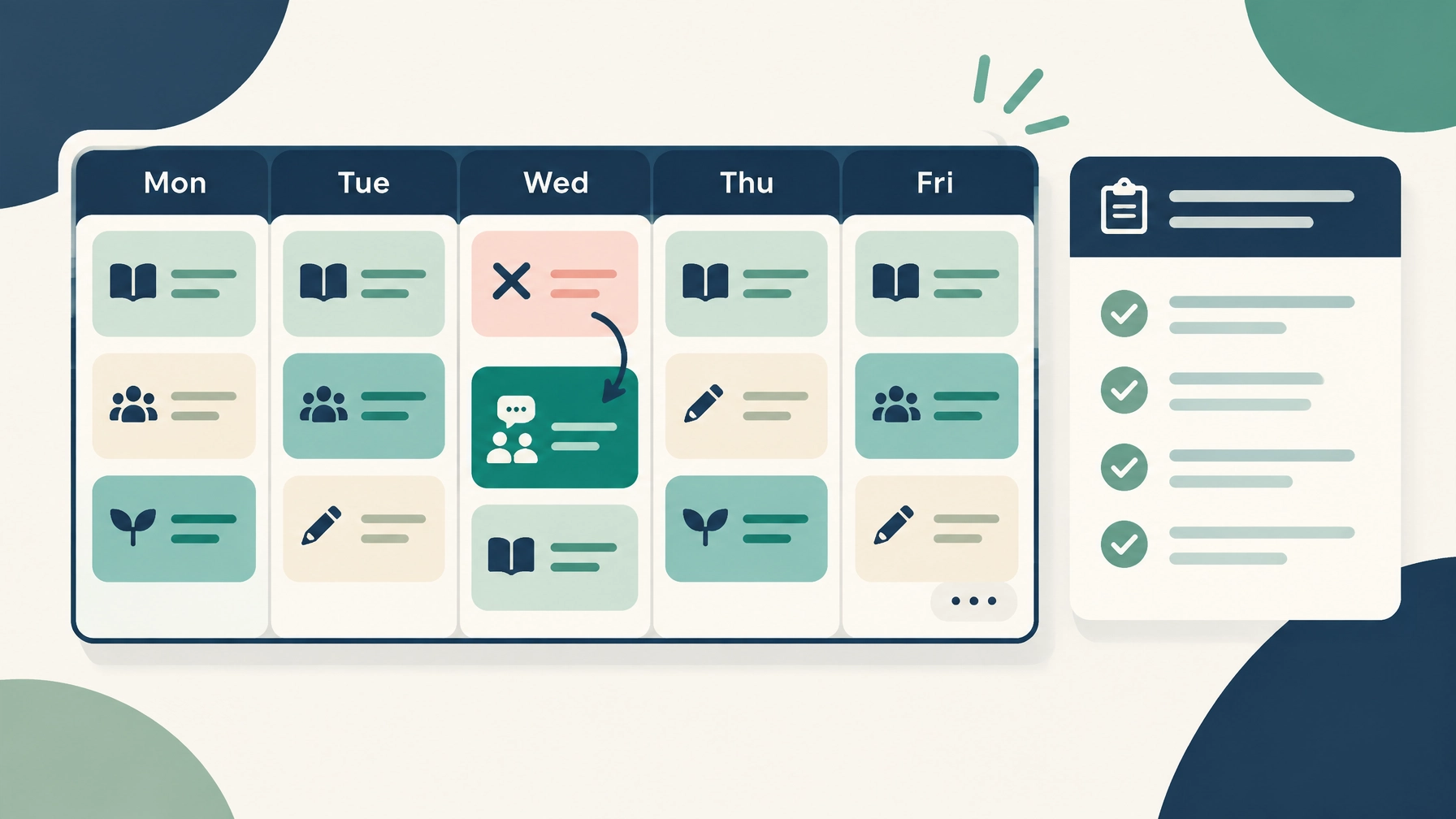
This is the thinking behind Teacher Sorted.
You can add the work in ordinary language, add the PPA or preparation time you genuinely want to use, and compare the two. If the week fits, you get a quick confirmation. If it does not, you can see the size of the gap before it becomes a Sunday night problem.
The tool does not create more PPA. It does not shorten a meeting. It does not decide which work matters most.
It can help you see what fits, what does not and where you left off. You still decide what to protect, move, reduce, postpone or discuss.
You can see how Teacher Sorted works if that approach would be useful. There is also a short workload check if you want to look at a coming week before it gets away from you.
The aim is not to produce a week with nothing left on the list. Teaching does not work like that.
The aim is to make the difficult workload decisions earlier, while you still have choices.
Let Sunday be a quick look at the week you have already considered, not the first time you discover that the work was never going to fit.
Plan against the time you have, and leave yourself a clear place to begin again.