
Teacher Sorted · 25 September 2026 · 9 min read
The hidden problem with teacher workload: everything feels urgent
Learn to distinguish genuine deadlines from perceived urgency, compare tasks with available time, adjust standards, and have clearer conversations when workload exceeds capacity.
When I taught Year 6, there was usually a point in the week when every job seemed to need doing next.
Marking. Planning. A parent email. A display that had been waiting for attention. Assessment data. A subject leader task. A form that someone had sent through with “when you get a minute” in the message.
There was always another job waiting.
The difficult part was not knowing that the work mattered. Most of it did.
The difficult part was deciding what could wait without feeling that I was letting somebody down.
That is the hidden problem with teacher workload. It is not only that there is too much work. It is that much of the work arrives looking equally urgent.
The newest email feels urgent because it is in front of you.
The unfinished marking feels urgent because you have already delayed it.
The planning feels urgent because tomorrow is getting closer.
The data task feels urgent because somebody else is waiting for it.
The result is that decisions often get made by whichever task is loudest or newest, rather than by what matters most.
Start by making the clash visible
A long list can make every task look the same.
“Mark books” sits next to “reply to parent”, “finish display” and “complete assessment spreadsheet”. The list tells you that all four exist. It does not tell you which one has a fixed deadline, which one affects tomorrow’s lesson, which one will take ten minutes and which one will swallow an evening.
You have to carry all of that information in your head.
That is tiring in itself.
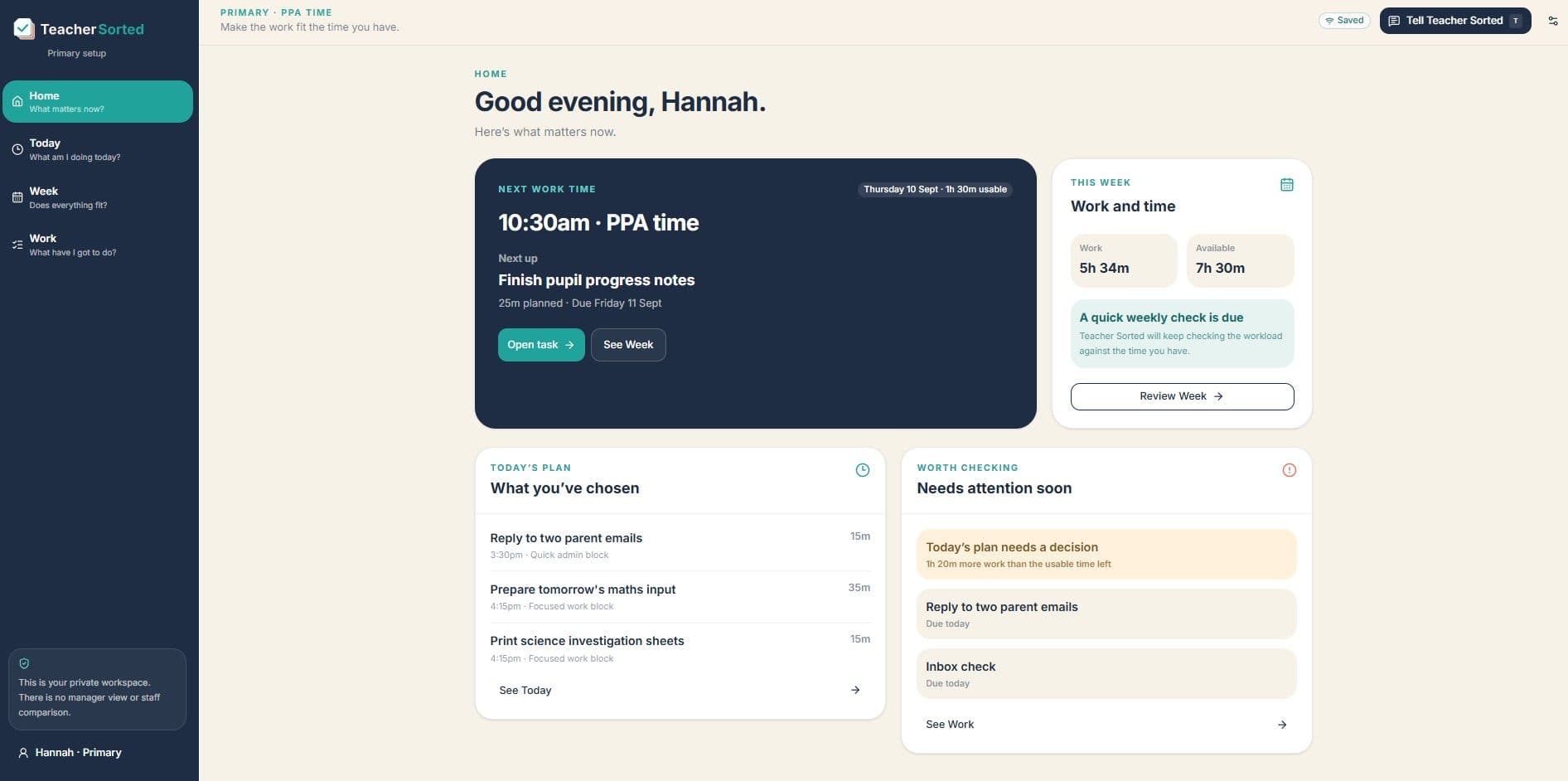
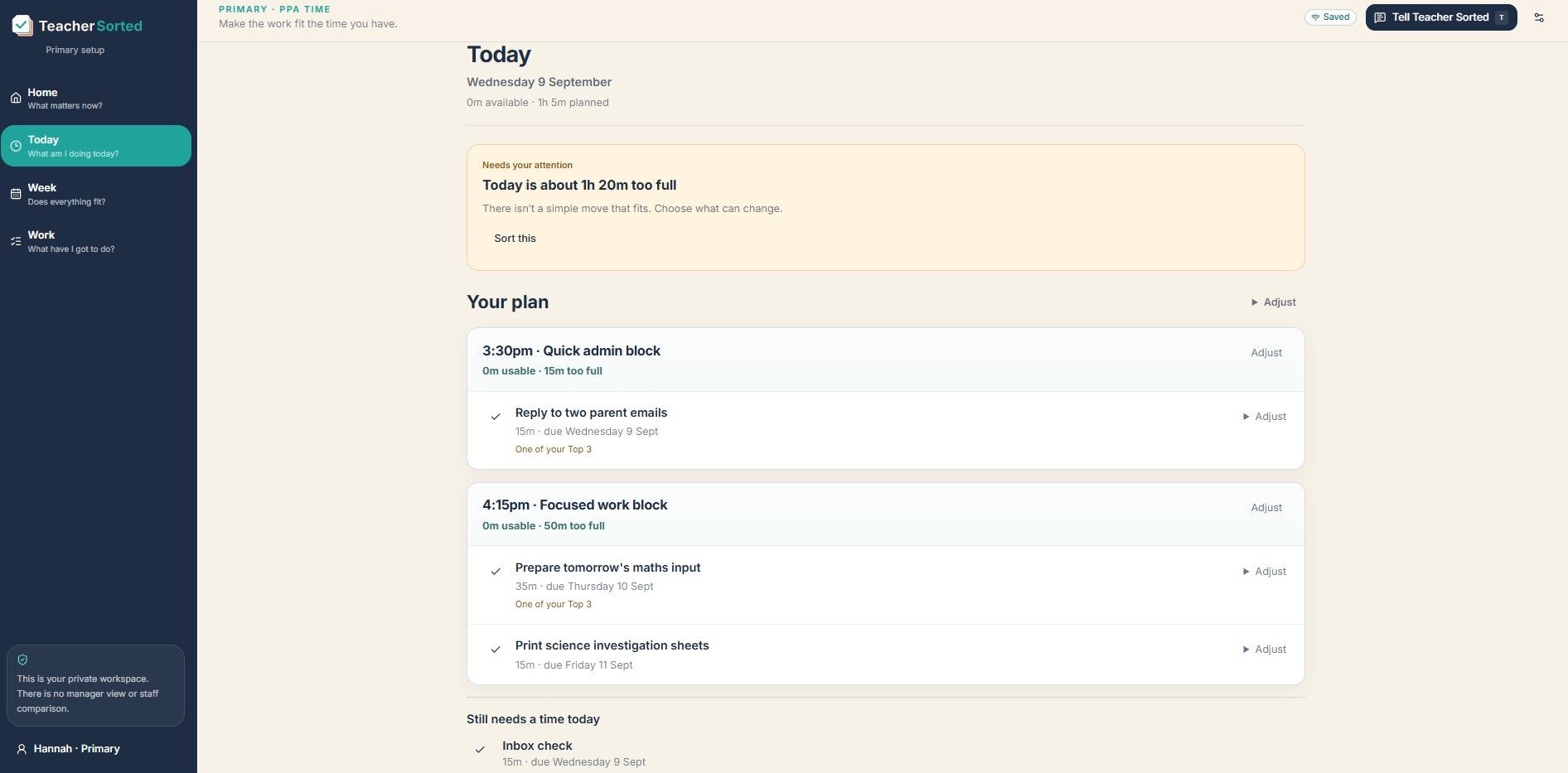
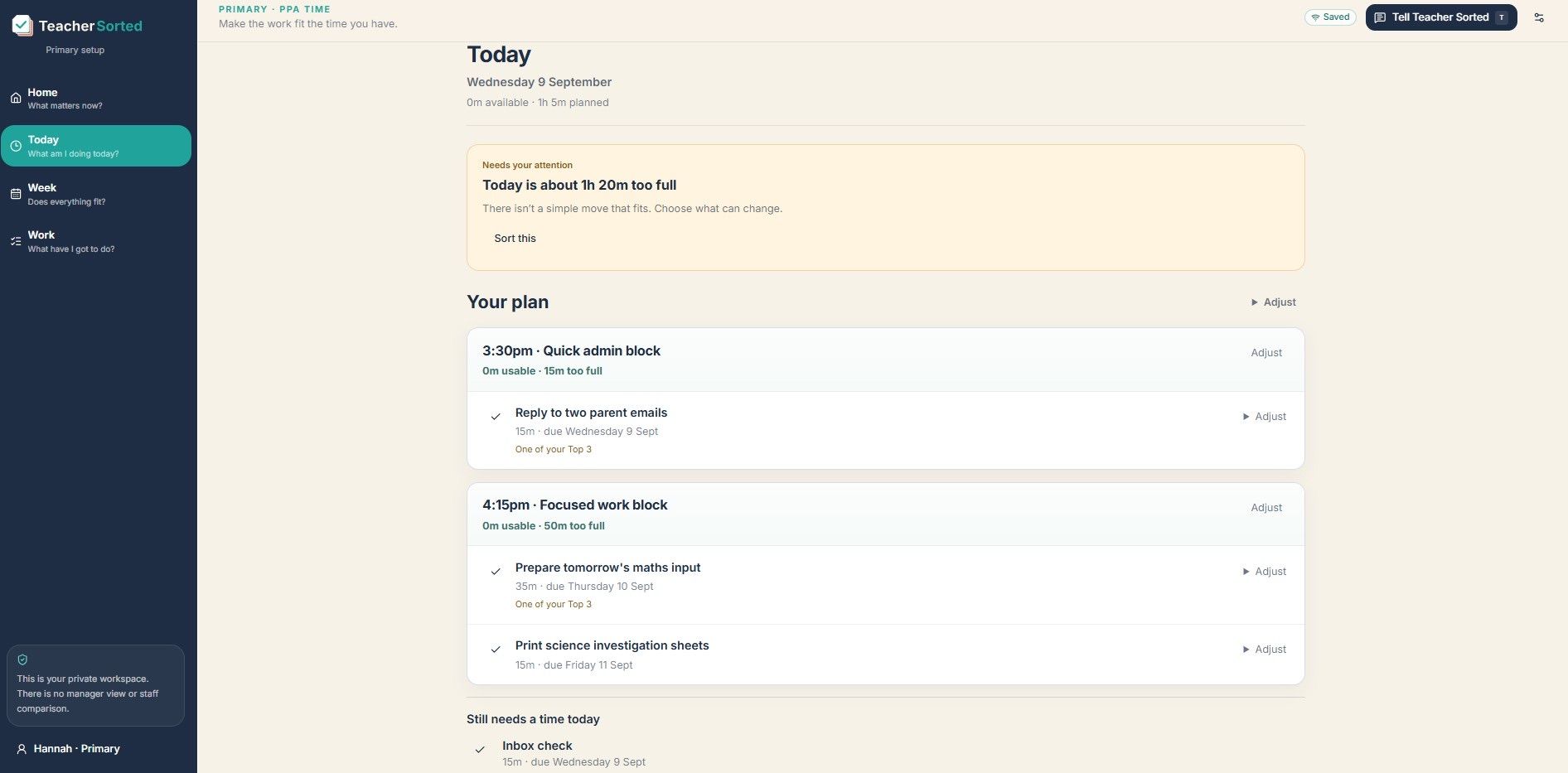
A better first step is to put the work alongside the time you actually have. Look at your PPA, preparation periods, meetings, duties and any other commitments. Include evenings and weekends only if you have chosen to make them available.
Then compare the two.
You might find that the week fits. You might find that it does not. Either result is useful because you are looking at the actual problem rather than carrying a vague sense that everything is pressing in at once.
Teacher workload research has repeatedly identified planning, marking, data and general administration as significant sources of pressure. The Department for Education’s workload resources and the Education Endowment Foundation’s review of teacher workload both point towards reducing unnecessary work, not simply finding ways to fit more of it into the day.
A plan with more work than time is not a plan. It is a list of future guilt.
Separate real deadlines from personal intentions
Not every deadline has the same weight.
Some deadlines come from outside you. A safeguarding concern needs dealing with. A report has to be submitted by a particular date. A meeting needs information before it starts. Tomorrow’s lesson needs enough preparation to teach it properly.
Other deadlines are flexible.
You may have decided to finish a display by Friday. That does not necessarily mean Friday is the only possible day. You may have planned to mark a set of books this week, but Monday might be acceptable if nothing depends on the feedback before then.
Then there are tasks that feel urgent because you have been thinking about them for a while.
That does not make them unimportant. It means the pressure may have come from repetition rather than consequence.
For each task, ask:
- Who set the deadline?
- What happens if it moves by a day?
- Who is waiting for it?
- Does anyone need the finished version, or just the information?
- Does this affect tomorrow’s teaching?
- Is there a smaller version that would be enough for now?
This is not an excuse to ignore responsibilities. It is a way to give each responsibility the right amount of weight.
“Finish the entire display” might become “put up the essential information”.
“Mark every book in detail” might become “identify the main misconceptions and plan the next teaching step”.
“Rewrite all the resources” might become “use last year’s version and change what needs changing”.
The work has not vanished. You have made a clearer decision about what it needs to look like.
Ask what happens if the task waits
When everything feels urgent, the most useful question is often simple:
What happens if I do this tomorrow instead?
Some jobs become more serious if they wait. Put those first.
Some create inconvenience but no real harm. Put them into the next suitable space.
Some feel uncomfortable because they are visible on your list, but waiting would make little practical difference. Those are worth reducing, questioning or removing.
A short set of questions can help you sort the pile:
- Does this affect safety, safeguarding or an immediate pupil need?
- Does it need to happen before the next lesson or meeting?
- Is someone making a decision based on it?
- Will doing it now change what pupils learn or what I need to do next?
- What is the actual consequence of waiting until tomorrow, Friday or next week?
You do not need a perfect answer. You need enough information to make one clear decision.
Teacher admin tasks often feel important because they have been requested by somebody else. That is understandable. But a request is not always a same-day deadline.
Ask:
Who will use this, and what will they do with it?
If the answer is unclear, that does not automatically mean the task can be ignored. It may mean you need to ask for clarification before giving it another hour of your evening.
Consider the effort, not just the importance
Two tasks can both matter and still need different decisions.
One might take ten minutes. The other might take two hours.
If you treat them as equal, you can spend your available time on a large job while several small but necessary tasks remain unfinished. Or you can clear a string of quick jobs and leave no room for the planning that tomorrow actually depends on.
Estimate the work roughly.
You do not need to know that marking will take exactly 47 minutes. “About an hour” is enough to make a better decision than treating it as a vague job that will somehow fit.
Then ask whether the task needs doing in its current form.
A quick parent update may not need a carefully drafted essay. A worksheet may not need a new design. A set of books may not need a detailed comment on every page.
“Good enough” does not mean careless. It means the standard matches the purpose and the time available.
When I was teaching, I sometimes spent too long making a resource look finished because that was easier than deciding what the pupils actually needed from it. The extra formatting felt productive. It was also a convenient way of avoiding the harder decision.
Would pupils notice the difference?
Would a colleague make a different decision?
Would you teach the next lesson differently because of the extra detail?
If the answer is no, the extra work may not deserve the time.
Make the conversation specific when the time does not fit
There will be weeks when sensible prioritising is not enough.
You can remove the cosmetic work, shorten the admin and protect the planning that matters most, and still have more work than time.
That is a workload problem.
The temptation is to carry the gap privately. You stay late. You work on Sunday. You tell yourself that next week will be calmer. Then next week brings a cover change, an over-running meeting, a difficult conversation and three more emails.
At some point, the useful next step is a clear conversation.
Take the work and the time available. Explain what can fit and what cannot. Ask which task should move, which standard can be reduced or which deadline should change.
You might say:
“I have enough time to complete two of these three tasks properly by Friday. Which would you like me to prioritise?”
Or:
“I can complete the data return, but I cannot also finish the resource revisions this week. Which one needs to come first?”
That is a professional conversation. It is clearer than attempting everything badly and hoping nobody notices the cost.
If you are using a workload planning tool, the useful part is not that it chooses for you. The useful part is that it shows the gap before the week disappears into evenings and weekends.
Leave yourself a way back in
Deciding that something can wait is easier when you know you will not lose it.
Before you stop, write down the first step for when you return.
Not:
- Finish planning
Try:
- Open the shared maths folder
- Use last year’s slides and change the starter
- Email Sam about the missing assessment
- Mark questions 1–5 first
This takes less than a minute, but it means you do not have to reconstruct the whole task when you are tired. You can come back to a starting point rather than a vague feeling that something is unfinished.
You can also leave a short note about what has changed. Perhaps the resources are already in the shared folder. Perhaps the deadline has moved. Perhaps you are waiting for somebody else before you can continue.
Stopping is part of managing the work. It does not mean the work has been forgotten.
The Teacher Sorted approach is built around this same problem. You add the work, compare it with the time you have chosen to make available, and see when the two do not fit. You can then decide what to protect, move, reduce, wait for or discuss.
It does not change deadlines or move tasks without your say-so. The decision remains yours.
Try one decision today
Choose one task from your list and ask:
- Does this truly need doing today?
- What happens if it waits?
- Does it need doing in this form?
- How long will it take?
- If there is not enough time, who needs to know?
Then make the decision and record it.
Some work will still be waiting tomorrow. That is normal. Teaching does not produce a perfectly empty list at the end of each day.
The aim is to stop every unfinished task following you home as if it has the same urgency.
You have limited time. Use it for the work that needs it most, and make the rest wait on purpose.